My grandfather, usually a man of many requests, had only one for me last winter:
To visit Hiroshima with him.
That was it. One request.
As all Japanese kids do, I had grown up learning about the atomic bombings, but I never imagined how much this visit would affect me. The stories, images, and artifacts I saw on that day didn’t just teach me history; they made me feel its weight, its pain, and ultimately, the strength of the people who lived it.
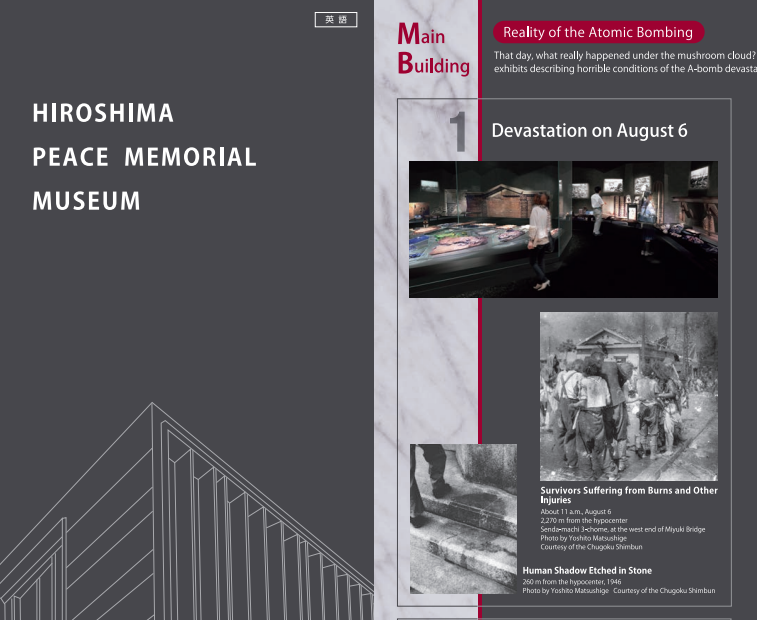
We visited the Hiroshima Peace Memorial Museum on a bright and sunny winter day, with not a single cloud in the sky.
Entering the museum brought me immediately into the “Hiroshima on August 6” exhibition. The lively environment of Central Hiroshima disappeared, and an eerie silence set in. Except for the occasional sniffle and shuffling, it was dead silent.
The exhibition started off slowly, showing a panorama of pre-war Hiroshima. The black-and-white images depicted the lifestyle of civilians as well as popular landmarks of the city. The exhibition followed a chronological order, making each room a step forward in time. Every step forward felt like I was getting closer to impending doom. The rooms in front seemed to pull me in like a massive black hole, drawing me towards the horrors that I was unable to escape.
Although I have been exposed to the harsh reality of the atomic bombings from an early age, nothing could have prepared me for what I would see in the next room.
There were countless images of young women and children burned to the point where their bodies seemed unrecognizable, suspended in a liminal space of life and death. Some stared into the camera with carved-out eyes, while some reached out their charred hands to the camera.
Along the pitch-black walls, there were stories of the survivors and the lives they lived before and after the bombing. The photos showed what the bomb took, but the words revealed what it did.
N was once a hardworking fisherman.
That day… N was exposed to the bomb at his building demolition worksite. He suffered severe burns over his body.
After two years, N recovered enough to go fishing once in a while, but that didn’t last long.
His wife, who had desperately worked to sustain the family, died in March 1951.
N decided to kill himself and his children.
He spent what little money he had on rice and fish for the children’s last supper. He waited for night to fall, then put his hands around the neck of one of his children. But he was unable to squeeze. When dawn broke, he had no choice but to live.
(“Hiroshima Peace Memorial Museum”)
(Taken from https://hpmmuseum.jp/)
As I read this story on the museum wall, I felt an immense sense of dread and hopelessness overcome me. I could not possibly fathom what would drive a father to kill his own children with his bare hands. The sheer hopelessness in this story hit harder than any fact or statistic could.
As I walked to the next door, it felt as though I was looking at something I was not supposed to—an invasion of privacy. A tattered brown rucksack, one splattered with radioactive rain and blood, belonged to a 10-year-old schoolboy. A seemingly brand-new navy robe, made for a husband by a loving wife, which the husband never lived to try on. A wristwatch with the time “8:15,” forever frozen at the moment the bomb detonated.
This level of intimacy with the tragedy felt deeply unsettling, as I was only separated from these artifacts by a thin layer of glass.
As we left the last room, I was quietly lost in my own thoughts. Although I had not realized it yet, it had been over an hour since we entered the museum. The time we had spent inside felt stretched out and heavy, still clinging on to me.
My grandpa broke the silence, commenting on his hunger. He knew a good food spot nearby, and wanted to have lunch. I half-heartedly agreed, still in my thoughts. It was just then that I realized my lack of appetite.
As we left the building and walked across the bridge, the surroundings felt eerily morbid, filled with an unsettling irony that lingered in the air. I could faintly hear the sound of children playing in a nearby park, running around and giggling.
The diner we entered was a quaint Japanese-style place, with soft jazz music and the gentle woody scent of Yakusugi.
There was a mutual understanding between us, as my grandfather slowly ate his curry rice, while my eyes wandered to the window overlooking the Motoyasu Bridge.
But 80 years ago, on a warm summer morning, a mother and her son were walking on the very bridge I was looking at. What would they have been talking about? Their hopes for the war to end, or what they were going to eat for dinner. The son could have been nagging his mother, “When’s Daddy coming home?” and before his weary-eyed mother could respond with her usual forced smile, the bomb would have hit the ground, and both of them, along with everything they called home, would have been vaporized in less than half a second.
But the majority of Hiroshima wouldn’t share the luxury of a painless, oblivious death.
The river below the bridge would soon overflow with little children, their mothers, and elderly relatives, all fighting for the water they believed would treat their burns. The mothers would hold their children tight to their chests, practically crushing their bones. Eventually, the mothers would lose their children in the infested swamp that was the river and drown alone in the thick blood, bodily fluids, and toxic radiation that was the Motoyasu River.
My grandfather had only one request: to visit Hiroshima with him. Walking through the museum with him, seeing the lives shattered and feeling the weight of their stories, I understood why he wanted me there: to share the true history of Hiroshima firsthand, and to pass it on to me, as one passes down a family heirloom.
I left the exhibition long ago, but the weight of it, and the memory of experiencing it alongside him, will never fall off my shoulders.