Water may possess the capacity to retain a structural or energetic imprint from substances that have been previously dissolved in it. This hypothesis, originally proposed by Jacques Benveniste in 1988, has generated significant skepticism within the scientific community, yet it continues to provoke investigation and debate.
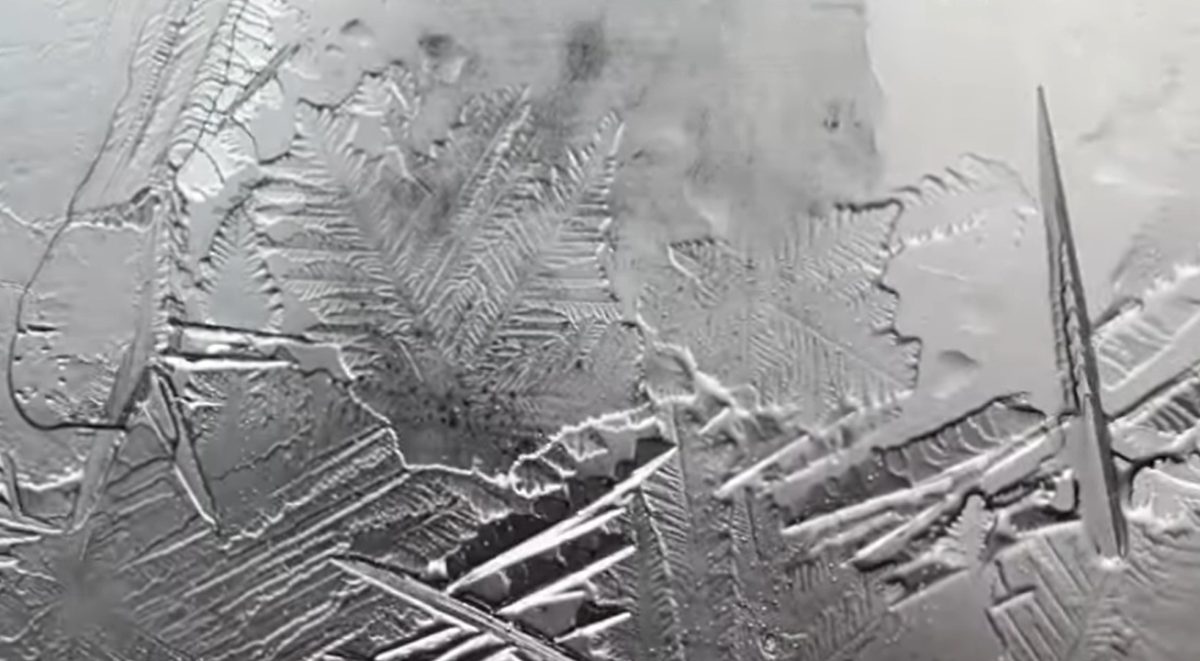
In The Living Language of Water, Veda Austin talks about her experience with water’s memory. She conducted numerous of her own experiments where she added water to petri dishes to thinly coat the bottom, put a picture under it, and froze the water at -23C or -9.4F. She freezes the water in three steps. First, she takes the samples out of the freezer and photographs them. The layer of ice is thin and has water on top of it. In the second freeze a layer of ice forms above the first. There is a layer of water in between the first and second layers. The third freeze is when the liquid water in between freezes. This section of the water is responsible for the darker color of the ice and the bubble effect. In one of her experiments, she placed water on top of a wedding invitation for 30 seconds and the water froze in the shape of a ring!
Veda Austin builds on the research of Dr. Masaru Emoto, who claimed that human consciousness could affect the molecular structure of water and attributed the shapes in the ice to the response of water to energy and intention, while mainstream science attributes them to the physical properties of water molecules and the influence of environmental conditions during freezing.
Researchers are looking into the phenomenon and how water could be holding memory. The hydrogen bonds within water could be the mechanism that water uses to store information, as sources could alter the lattice of hydrogen bonds in water. This information could come in the form of light or sound. Veda Austin did experiments where she would place a petri dish of water beside a speaker, play a song, and return after the song was done and freeze the water. When she played Taylor Swift’s song “We Are Never Getting Back Together,” the word “EX” appeared.
Following her work, several key developments and impacts have occurred. Veda Austin has become a prominent public speaker, appearing on numerous podcasts and at events where she shares her findings and perspectives on water as a “source rather than a resource”. She uses her water crystal photographs as both scientific data and artistic expression. She continues to use her unique freezing method to capture “HydroGlyphs” (water’s consistent responses to specific ideas or words) and shares these discoveries online to challenge conventional views of water.